

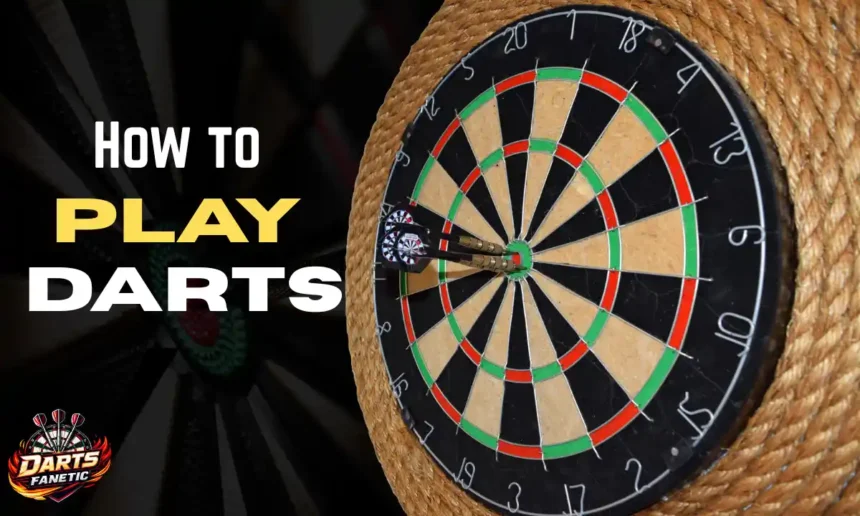
Darts is a skillful, fun game you can play at home, in some pubs or even professionally. Combining precision, focus, and strategy, it has everything to delight even casual players, but also returning players looking for a little competition.
This complete guide will teach you how to play darts while covering the essential rules, scoring, throwing styles, and ways to play each game.
What You Need to Play Darts
Before you go, ensure you have the appropriate gear:
- Dartboard – A typical bristle dartboard or an electronic dartboard seems numbered 1–20, with doubles, triples, and a bullseye.
- Darts – 3 darts (brass or tungsten barrels, normal flights, and plastic shafts are ideal for novices).
- Oche (throw line): A line on the floor behind which a player has to throw, usually 7 feet 9¼ inches (2.37 m) away from the face of the board.
- Scoreboard or App: 501/301
Which is why having nice equipment means less worrying about chest cranking and focusing more on technique and strategy.
Dartboard Basics and Scoring
It is essential to understand the layout of the dartboard in order to learn how to play darts.
- The outside ring is the double ring (double the number).
- The inside ring is the triple ring (triple the number).
- The center is called the bullseye: outside bull (25 points), inside bull (50 points).
- Single is any normal section that is not on the double or triple ring.
The maximum score for 1 round (3 darts) is 180 points (triple 20, triple 20, triple 20). Knowing this helps you calculate scoring and finishing strategies in games like 501.
How to Play Darts: Basic Rules
Generally, dart games share a similar structure.
Decide who goes first
- Each player throws a dart at the bullseye
- Play The play starts with the player closest to the bullseye.
- Or, you can just flip a coin, or do rock‑, paper‑, scissors.
Turn order and throws
- Players throw 3 darts a turn in a turn-based format.
- The only division between the two throwers is that they have to throw one dart at a time while standing behind the oche.
- A dart that rebounds, falls out, or lodges itself into another dart 0.
Scoring and game flow
- So, given these 3 throws in a turn, summing it to get the final score of that turn.
- Use a scoreboard/app to maintain the score after every turn.
- The game ends when a player reaches the required finish (e.g., reaches 0 in 501 and ends on a double).
Most popular games are governed by this simple ruleset, which means that once you master them, you can easily move between formats.
How to Hold and Throw a Dart
You can not make it go in the hole without having a very solid grip and stance.
Choose the right stance
- Position yourself with your dominant‑foot side forward, toes not far off the oche.
- Stand shoulder-width apart; balance your weight
- Lean just forward so your throwing arm has a smooth flow towards the target.
Grip the dart correctly
- Grip the dart barrel by using either the thumb, index finger, and middle finger.
- Do not pinch it too hard! you have to be relaxed to let go of a smooth release.
- Locate the center of gravity of your dart, and always grip just behind this point to promote a balanced throw.
Aim and release
- Choose a shot (e.g., triple 20 or bullseye) and stick to it.
- Focus on the target the entire throw.
- Swipe in a slow, straight line—never swing wildly or flick your wrist as you do with a mouse.
Repeat this very simple approach each time you spend 10–15 minutes building muscle memory and developing your aim.
Popular Dart Games to Try
After learning a little, you can play various types of dart game. Here are three beginner‑friendly options:
501 – The Classic Dart Game
- Start with 501 points each.
- Each turn, you take the top score and subtract your score until 0.
- The last dart has to land in a double (also the double bull)
- The format played in professional tournaments is the ideal test of your scoring and finishing abilities.
301 – Easier Scoring Version
- All the same rules as 501, but play starts at 301 points.
- I think it’s good for new folks: since mistakes matter less, and games are shorter.
Around the Board (Number by Number)
- Shoot at every number from 1 to 20 and the bullseye in order.
- Finish the game by hitting 1 of each number (or hitting doubles only).
- This drill enhances overall accuracy.
These games help you practice various targets, score management, and gain confidence very quickly.
Tips to Improve Your Darts Skills
If you want to know how to improve at darts, it comes down to practice and consistency.
Warm up before every game:
- Take 5–10 minutes to loosen your arm by throwing at bullseye or the 20s, and focus an eye.
Practice-specific targets:
- Practice triple 20s, and then doubles (1–20 and bull).
- Utilize basic drills such as “Hit five doubles in a row” for consistency.
Develop a repeatable routine:
- Use the same spot, the same stance, and follow through in the same way.
- That leads to more consistent scoring,
Stay calm and focused:
- Feel free to take that quick breather while aiming and don’t rush on your throw.
- Focus: no eyes off between darts, look at the target.
Record your scores:
Keep track of your average score per turn for multiple games. Seeing this average increase is a definite sign that things are looking up.
Common Mistakes to Avoid
Even experienced players make errors. Here’s what to watch out for:
- Incorrect stance: Standing too far back or leaning too far forward can ruin your aim. Fix your positioning according to the rules.
- Over‑gripping the dart: A tight grip makes throws jerky and less accurate. Keep it relaxed.
- Ignoring the double finish: In games like 501, many players forget to plan their finish and end up “busting” (going below 1). Always think ahead.
- Throwing too hard: Excessive force makes darts unstable in flight. Aim for a smooth, controlled throw.
By fixing these mistakes, your game will become cleaner, more precise, and more enjoyable.
Fun Ways to Play Darts with Friends
Darts is even more fun when you make it into a social game:
- Team games: Play 2‑vs‑2, alternating between each participant on both teams taking ownership of the score.
- Horse race or “killer”: Everyone has a number, and you try to hit it over and over again as opponents attempt to “kill” you by hitting your number.
- Handicap games: Give the stronger players head starts to allow some semblance of competitive balance.
These labels help to keep the game fun and introduce beginners without any pressure.
Conclusion
You can easily learn about how to play darts by knowing these four factors equipment, scoring, rules and technique. You can sharpen your accuracy and have more confidence with practice and discipline.
Variety of the areas of gameplay, whether you are playing casually with friends or looking to compete, darts gives you a fantastic balance between fun, focus, and strategy.
Also read about: How to Make Paper Darts: A Complete Step-by-Step Guide for Beginners