

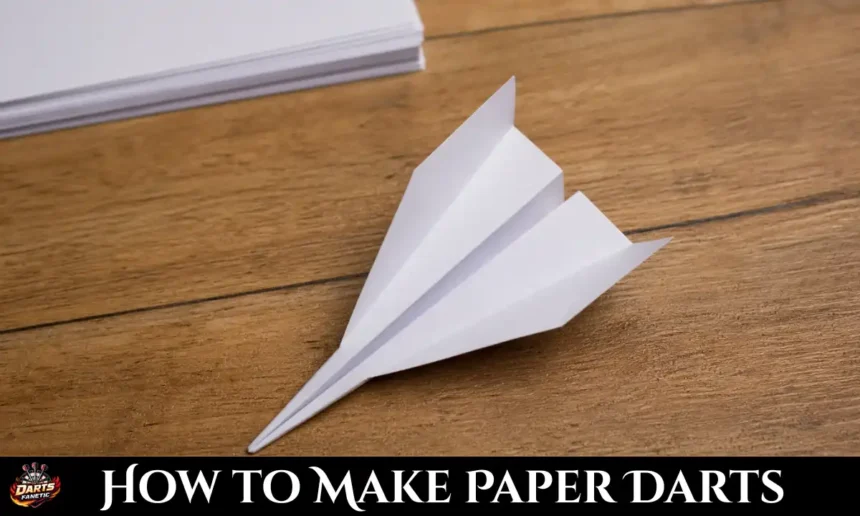
If you want to enjoy yourself more fully and have fun with your friends, a budget-friendly creation activity is learning how to make paper darts. Requires only a piece of paper and some easy folding skills, but gives hours of fun. Paper darts are also ideal for kids at school, as well as adults who indulge in hands-on art. Not only are they fun to make, but they also aid focus, creativity and coordination. This complete Guide will teach you easy folding techniques and expert tricks to get your paper darts go faster and further.
What Are Paper Darts?
Paper darts are pointy flying things made of paper folded to an aerodynamic shape. Similar to the paper airplanes, but darts are typically more aerodynamic and built for speed/accuracy rather than distance gliding. Their pointy nose and short body allow them to travel faster and strike more accurately. It makes them well-suited for playing indoor games as well as competing in friendly matches.
Materials Required to Make Paper Darts
Perhaps one of the best parts of paper darts is how easy it is to make these. All you need are a few things:
- Rectangular paper (A4 best professional usage)
- A flat surface for folding
- Ruler (optional, only to make super straight folds)
You can even use colored paper or recycled sheets for your darts to make them look fantastic.
Choosing the Right Paper for Best Results
Paper has a great impact on the performance of your dart. This is what each paper does for your results:
- Standard A4 Paper: It absorbs folding Extreme stress, and the performance is fairly balanced, which makes it a great option for beginners.
- Thick Paper: Makes stiffer darts that may last longer, but do not fly as far.
- Thin Paper: Since it is lighter, it goes further but may not fly very straight.
Tip: Always use clean, wrinkle-free paper for optimal results. Folded paper or damaged paper will affect the symmetry of a dart, and therefore the flight path.
Step-by-Step Guide: How to Make Paper Darts
Here are the simple instructions to make a perfect paper dart:
- Step 1: Take a rectangular piece of paper and set it up vertically on the desk.
- Step 2: Fold the paper vertically from the left edge to the right edge. Press firmly to keep the folding and then unfold the paper. This step will create a center line for folding.
- Step 3: Next, take the top left and top right corners of the paper and fold them towards the center. In this way, make a triangular fold on the top of the paper.
- Step 4: Fold the inclined sides inwards so that a sharp and pointed tip may be formed. This will enhance speed and precision.
- Step 5: Now fold the entire paper vertically along the center line made previously, with the pointed tip being folded outward.
- Step 6: Then, fold the upper part of the paper towards the bottom to make wings. The wings must be equal on both sides.
- Step 7: Bend the wings slightly upwards at an angle for stability during flight.
Your paper dart is now ready for use. Just hold it with the point being towards your side and launch it gently forward.
Folding Techniques for Perfect Paper Darts
Be cautious of the manner in which you’re folding your dart, make these moves correct, and your dart will fly farther like an arrow.
- Always make sharp, clean creases
- Precision symmetrical balancing of both sides
- Press on the folds so they hold and take shape
- The pointed, narrow tip should improve aerodynamics
The difference between a dart that flies like an arrow and one that falls like a stone is good folding.
Tips to Make Your Paper Darts Fly Farther
Try these tips to shoot your dart like a pro.
- Instead, throw with constant motion as opposed to force.
- This improved lifting capability means that to ascend, the wings were pitched up a little
- Make the dart balanced with both sides
- Try out a variety of papers to see which kind suits you
- Just don’t go crazy putting weight on the dart.
Darts have distance and travel accuracy capabilities that are absolutely astounding; even tiny adjustments can go a long way.
Common Mistakes to Avoid While Making Paper Darts
Simple mistakes that impact performance are common with beginners. Here’s what to watch out for:
- Uneven folds that cause imbalance
- Using crumpled or torn paper
- Making wings too wide, or too narrow
- Altering the trajectory of a fold, a decrease in velocity
- Overthrow, which displace dart throwing path
By learning how to avoid these mistakes, better and more consistent results will come through experience.
Different Types of Paper Darts You Can Try
Once you’ve mastered the basic design, you can experiment with different styles:
- Classic Dart: Simple, fast, and easy to make
- Heavy Dart: Uses thicker paper for stability
- Mini dart: small, relatively and quickly flying
- Glider Dart: Aimed at staying in the air longer
Experimenting with different variations can inject some fun into the activity and possibly reveal which design works best for you.
Safety Tips While Playing with Paper Darts
Paper darts are relatively safe, although you should still take a few basic precautions:
- Do not point at people — ever, especially at the face or eyes
- Avoid throwing near fragile objects
- Use open spaces for playing
- Keep an eye on your little ones while playing
Safety is the ability for everyone to engage in an activity so that no timing issues arise.
Fun Games to Play with Paper Darts
The fun part about making paper darts is that you can also play some games with them:
- Target Practice: Shoot at a box, wall target, or drawn circle
- Distance Challenge: How Far Can You Throw?
- Accuracy Contest All about hitting the right spots to rack up points!
- Indoor Competitions: Go head-to-head against friends or family
These games render the experience in a much more interactive and fun manner.
Benefits of Making Paper Darts (Creativity & Skills)
You have this very basic activity, which has quite a few advantages apart from just plain old entertainment:
- Improves hand-eye coordination
- Enhances concentration and patience
- Encourages creativity and problem-solving
- Develops fine motor skills
- Provides a screen-free, relaxing activity
- It’s a good way to learn, having fun.
Conclusion
Paper darts are one of the easiest, yet most fun things anyone can make. All while only needing a single sheet of paper and some simple steps to design one fast flying, accurate dart. With practice, trial, and error, you will learn as you design darts which design works best for your darts. They are ideal for both entertainment and learning, whether you do it for fun, creativity, or just to compete with your friends.
FAQ’s
What is the best paper for making paper darts?
Standard A4 paper works best for beginners due to its balance of weight and flexibility.
Can kids make paper darts?
Yes, it’s a safe and easy activity for kids with proper guidance.
How can I make my dart fly farther?
Use lightweight paper, ensure proper balance, and throw gently with control.
Also read about: How to Play Cricket Darts: A Detailed Guide For Beginners